A Crescent Moon Beneath the Bridge, 「Lunar Crescendo」
How thirty-seven rings of light became one moon
Dec 25, 2023
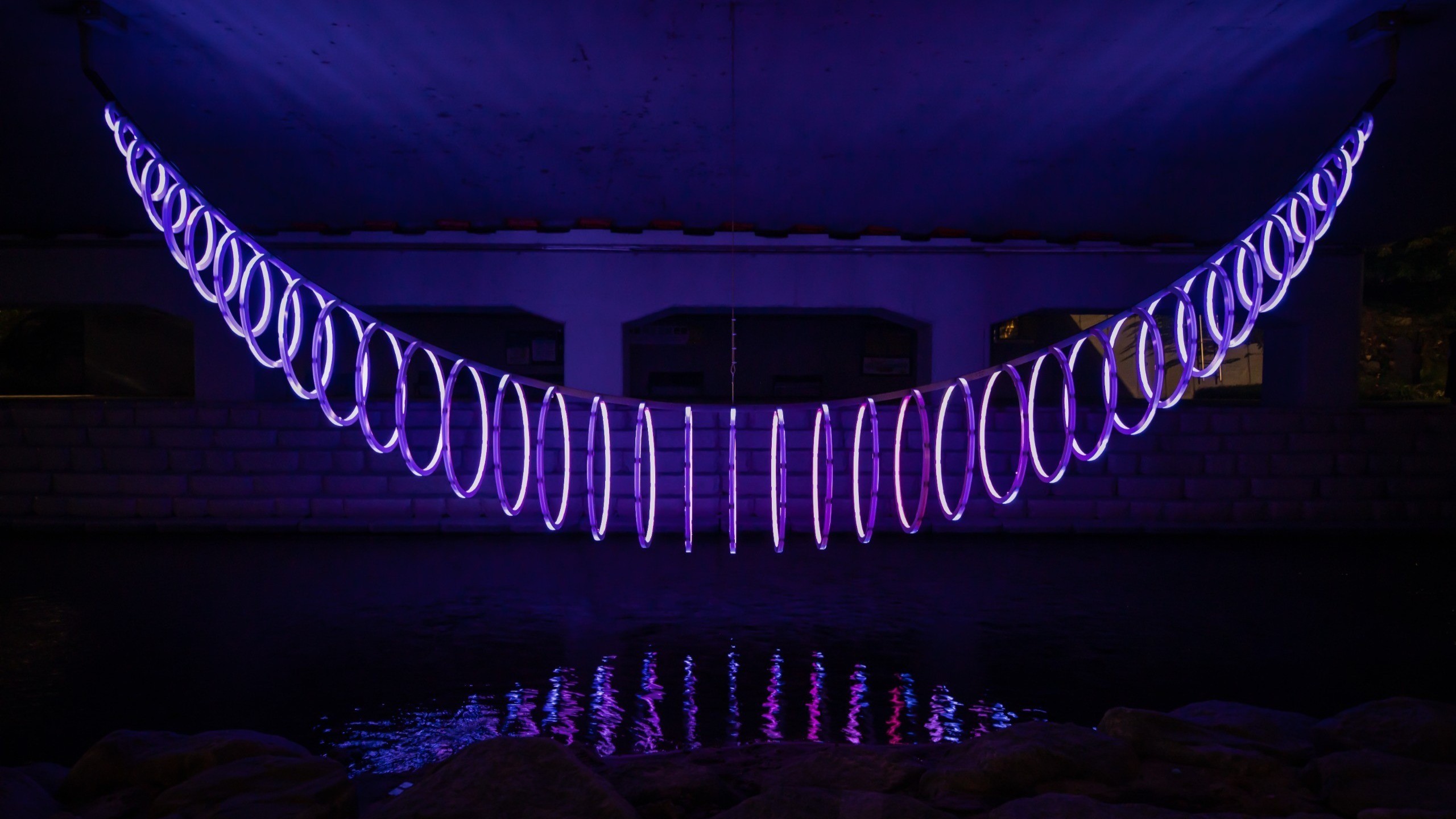
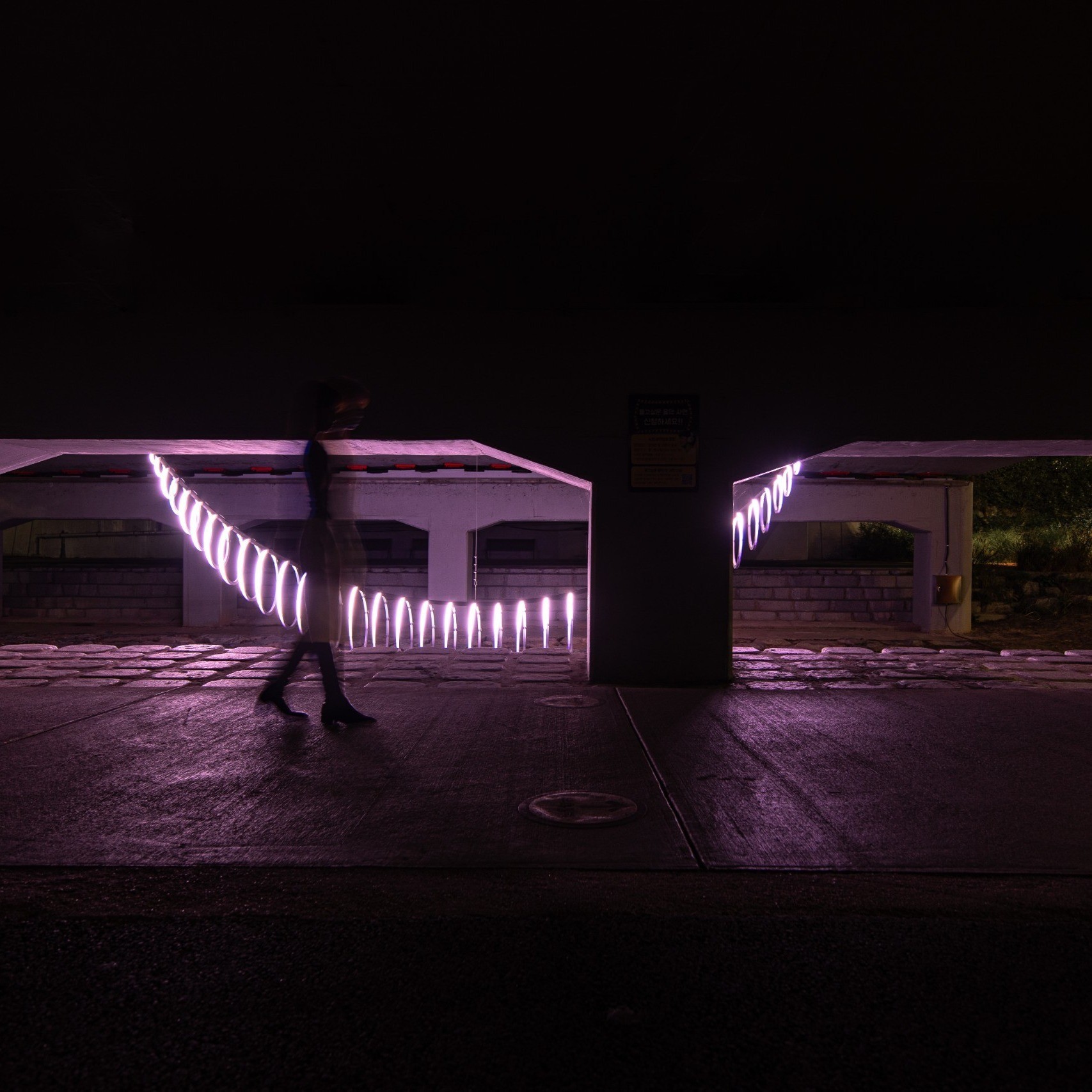
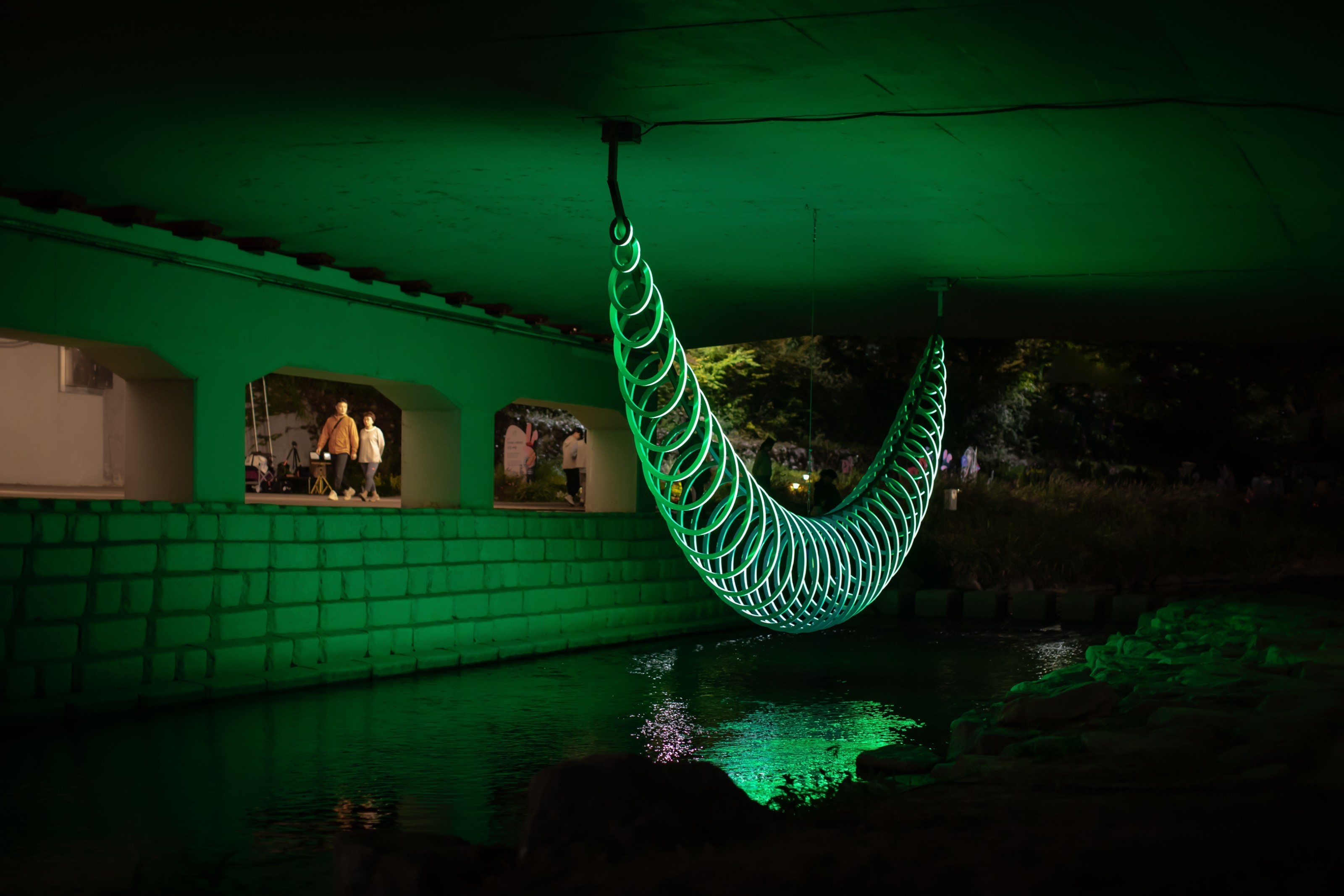
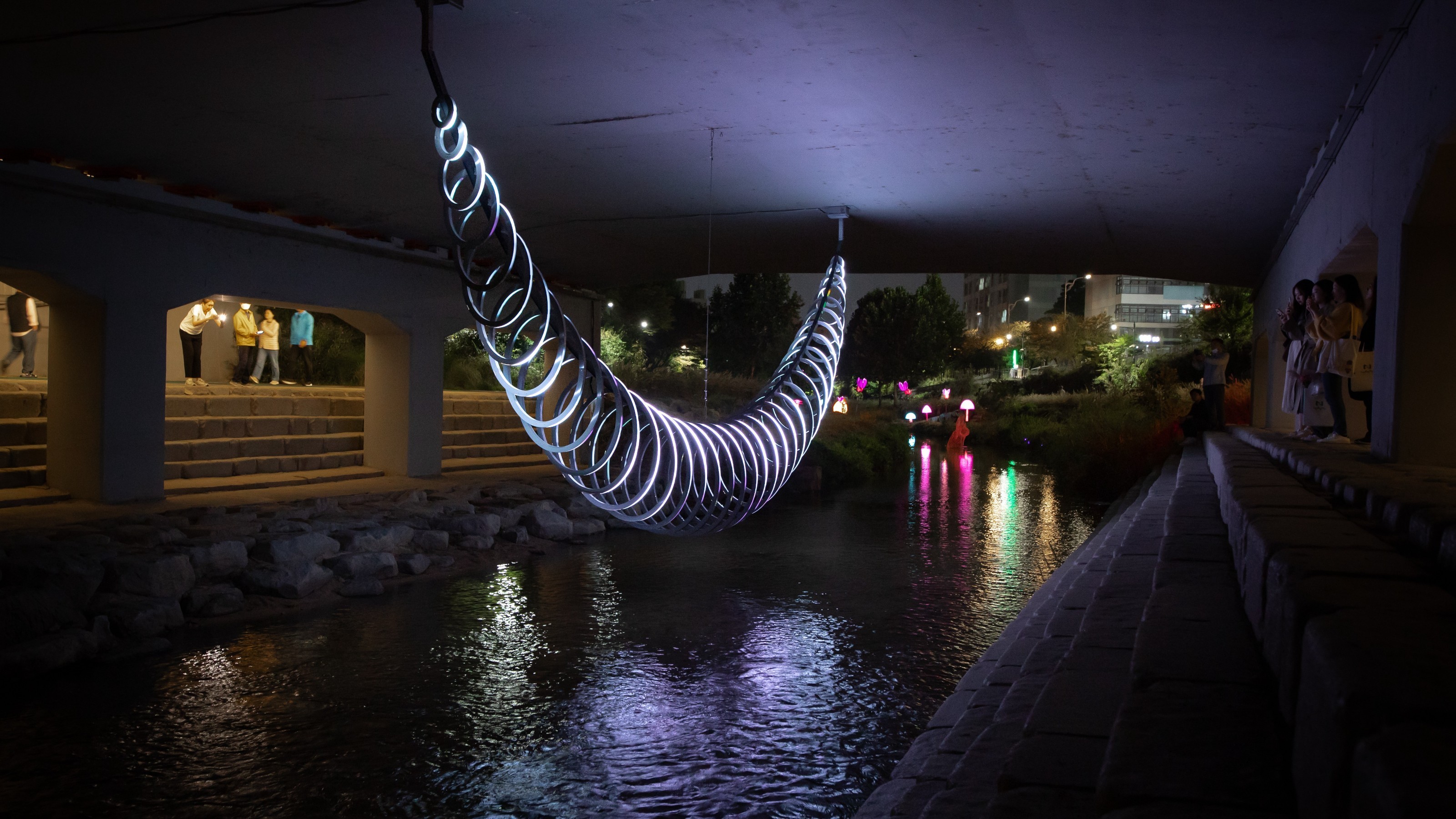
October 2023, Danghyeoncheon Stream in Nowon, Seoul, during the "Nowon Moonlight Walk" festival. Beneath Danghyeon 3 Bridge hung a crescent moon made of thirty-seven rings of light. Drawn with lines of light instead of a screen, it was the first work Apollon Immersive Works presented as an artist. People walking along the stream sat on the steps under the bridge and stayed for a long while. From a first concept that failed in testing to a sudden flood in the final days of the exhibition, we spoke with the three people who made it.
TJ Lee Supervisor, SH Lee Creative Director, JH Soong Proejct Director
This work was created from scratch for the festival. What did you hope for, and what worried you?
TJ It was the first work Apollon presented as an artist. Unlike a commercial project, it was a chance to show our own ideas, so I really wanted to get it right. Once the concept was set, I loved it so much that I just wanted to build it, open it, and see how people would experience it. That moment was what I looked forward to most the whole time. My worry was the schedule. Whether we could realize the original vision within the time we had was my biggest concern. The process was hard, but we worked with real excitement.
HJ What I liked was that we started from the place. We weren't bringing in a finished work. We could design form, content, and sound as a single experience shaped by the conditions of a public space, Danghyeoncheon. But it was an outdoor stream, so water levels and weather were beyond our control.
SH My biggest worry was installation. We chose the stream because light reflected on water would bring the work to life, but there were many questions. Should we hang it from the bridge, or build a temporary structure in the water? How could we keep it safe while hiding the supports? It was a project where standing the form up in a real space took as much thought as designing the form itself.
Why lines of light rather than a screen?
HJ We looked at several directions: shaping light into a single form, spreading it across the whole space as a landscape, or framing it like a screen. A screen didn't feel right for a walking path. People here are in the middle of a walk. Rather than stopping them in front of a screen, we felt a scene they come upon while walking suited the place better, so we leaned toward giving the light itself a form. And we gathered that form into a moon.
TJ We also looked at LED frames, pillars, and projection mapping, but we'd seen them all many times. We could guess how they would turn out. So we decided to make it look as if we had designed an architecture called the moon out of lines of light, and to create new hardware and a new way of expression of our own rather than using existing hardware.
SH Lines also let us express the moon lightly. We wanted thin lines of light to come together into one moon that seems to float above the water. It helped keep the structure light, too.
Why a crescent rather than a full moon?
TJ It was right after COVID, when people were just starting to come back outside. Everyone was very tired. In music, crescendo means "gradually louder," and it comes from the Latin crescere, to grow and flourish. Crescent, the word for the waxing moon, comes from the same root. People usually reach for the full moon, but we wanted to talk about the crescent, the moon that disappears after the full moon and starts to fill again. A time of preparing and recharging for the full moon of your life. We felt that matched the moment. We hoped people would rest in front of the work for a while, mind at ease, and fill up their energy.
The original concept proved hard to realize in lighting tests. What was the idea, and how did you take it?
HJ The idea was to connect beams of light crossing between the bridge piers with reflective materials to form a single shape. But in testing, outdoors and without devices like mist, the beams weren't nearly as clear as we had imagined. It was a real disappointment, but the result was clear, so we couldn't hold on to it for long. We changed direction quickly and planned a new concept.
TJ We were watching that test with the festival's general director, and both the director and we were at a loss. We had thought it was a pretty good idea. But looking back, it was part of the process of arriving at something better. Without it, Crescendo wouldn't have been born.
SH I actually felt relieved. It was a limit we had partly expected, and we confirmed it early in production. Testing is about checking what's possible, but it's also about finding out quickly what doesn't work and looking for alternatives.
You moved from beams in the air to rings. What changed, and what carried through?
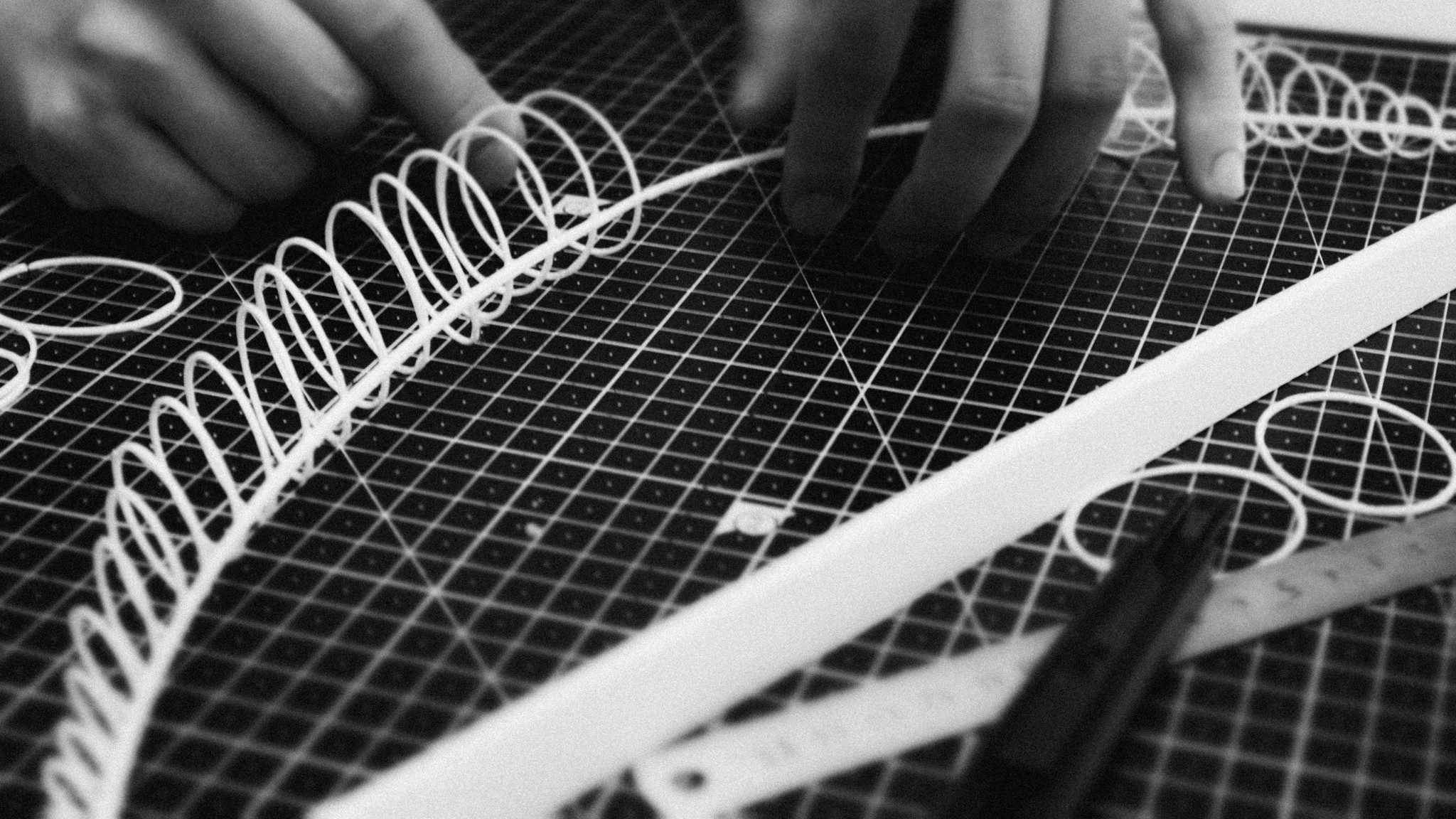
SH Instead of drawing trails of light in the air, we came to design a sculpture that holds the light. Starting from small oval rings that grow larger and then smaller again, we built the curve of a crescent. It also let us clearly show light traveling along the rings in a real space. The way of expression changed, but we kept our original intent to the end: showing light flowing organically.
HJ The concept changed too. The idea of a twelve-month cycle shifted to the phases of the moon. We put five forms side by side within the same concept, debated them intensely, and settled on one symbolic form. The failed test actually made the work clearly a "moon."
TJ This is also when we chose the site. We walked along Danghyeoncheon and looked at a lot of spots. Danghyeon 3 Bridge has walking paths and steps on both sides, like a runway with seating on either side. Below, the stream runs in a straight line. I thought a long, extended work would look great hung above it, and that was Crescendo.
Each ring glows on its own, yet from a distance they had to read as one moon.
SH The key was the connection of light moving between the rings. Thirty-seven rings were laid across more than 11 meters, but to visitors it had to look like a single light flowing without a break. We kept checking the direction and speed of the light and how it passed from ring to ring. We believed the rings would read as one moon only if that connection felt natural.
HJ I focused on keeping the rings from looking like light fixtures. We joined rings of different sizes so the whole read as one mass, and designed content for each ring separately so that even when they flickered one by one, it felt like a single movement. Up close they had to be rings, and from afar, a moon.
TL We had different content flow on the inside and outside of each ring. Like a person's inner and outer self, the inside and outside move differently, so you see the content and the form together. Even its reflection on the water had to be beautiful.
How did you complete the roughly ten minutes of light and music?
SH Simply turning lights on and off couldn't fill ten minutes. We divided the piece into three movements and gave each scene its own movement of light and emotional flow. With the content artist, we spent the most time aligning rhythm, transition timing, and overall tone.
TJ The final tuning happened on site. The first version of the sound echoed too much under the bridge, so we revised the music and visuals many times, listening for the frequency ranges that carried well in that space. The bridge's landscape lighting was another problem. It was so bright that it was hard to be absorbed in the work. We persuaded the district office and the relevant departments to keep only the lighting needed for walking and switch off the rest during the exhibition. It was harder than we expected.
With a tight schedule and unexpected problems, what kept the team going?
HJ The most exhausting part was construction right before installation. Working above a flowing stream, unexpected problems came up again and again. Still, what gave me the most strength was watching the rings light up one by one and take the shape of a moon. During the on-site test, when sound and light came together for the first time and music echoed under the bridge, I was certain: "This is going to work."
SH With content, sound, and hardware each being developed separately, our interpretations sometimes diverged. So whenever possible, we brought our work and gathered in one place. Seeing light and music together in the same space made each other's intentions clearer and let us decide on revisions quickly. During on-site tests, passersby stopped out of curiosity and filmed the work, and that kept us going to the end.
TJ For me, the process itself was fun. Combining everyone's expertise to make something good is genuinely exciting. The artist who created the sound, the designer who designed the hardware with us, and the developer who actually engineered and built that hardware stay with me in particular.
The stream was both a material that completed the work and a condition that was hard to predict.
TJ For us, water was a material. It's a crescent moon floating on water, after all. We studied the water levels for that season and set the height so the moon wouldn't sit too far above the surface. That way its reflection looks more beautiful. But nature didn't always follow our calculations. A few days before the exhibition ended, we got a photo showing the stream had suddenly risen and swept half the work away. When we rushed over, rings were bent by the current and some parts were broken. Fortunately, we repaired it without it showing much and finished the exhibition.
SH The same content became a different scene depending on the weather. On calm days the moon was reflected as clearly as in a mirror, and on windy days the light rippled with the waves. You could never see that in an indoor exhibition. Going through that, though, I felt firsthand that outdoors, weather beyond your expectations really does happen.
HJ When we were designing, it was a variable. Once the work was finished, it was a material. From the start, we thought about using the weather rather than trying to beat it.
Once the festival began, did you see the scene you had hoped for?
HJ We hoped people on a walk would pause, rest, and leave feeling like they were starting fresh. As the festival went on, more and more people rested under the bridge and watched the work. It seemed our intent came across without any explanation or text, and I was relieved.
TJ Many people sat on the steps on both sides for a long time before leaving. Couples, families, mothers with children. Older visitors especially loved it. It was probably an experience they had never had before. Some came back often just to see it.
SH At first, many people just glanced at it while passing by, which was a little disappointing. It's an everyday walking path, after all. Instead, many people filmed the moving light on their phones. We had hoped it would be recorded as video, with light and sound together, rather than as still photos.
If you could go back under that bridge?
TJ I still love "Lunar Crescendo" as it is. But Apollon is a company that creates permanent spaces and media, and this was the first temporary work we made. Today no one can touch or experience it anymore; it remains only in videos and images. If the chance comes, I'd like to bring it back as a work people can see permanently.
SH I'm curious about other ways of expressing it. Because it was a crescent, visitors easily recognized the motif, but if the sculpture itself had moved, in a kinetic way, I think we could have shown the moon's changes more dimensionally.
HJ I have no regrets. I believe we ran every test we could in that short time. If I went back, I think we'd run the same tests in the same order, wrestle with the same questions, and end up making this same moon.